
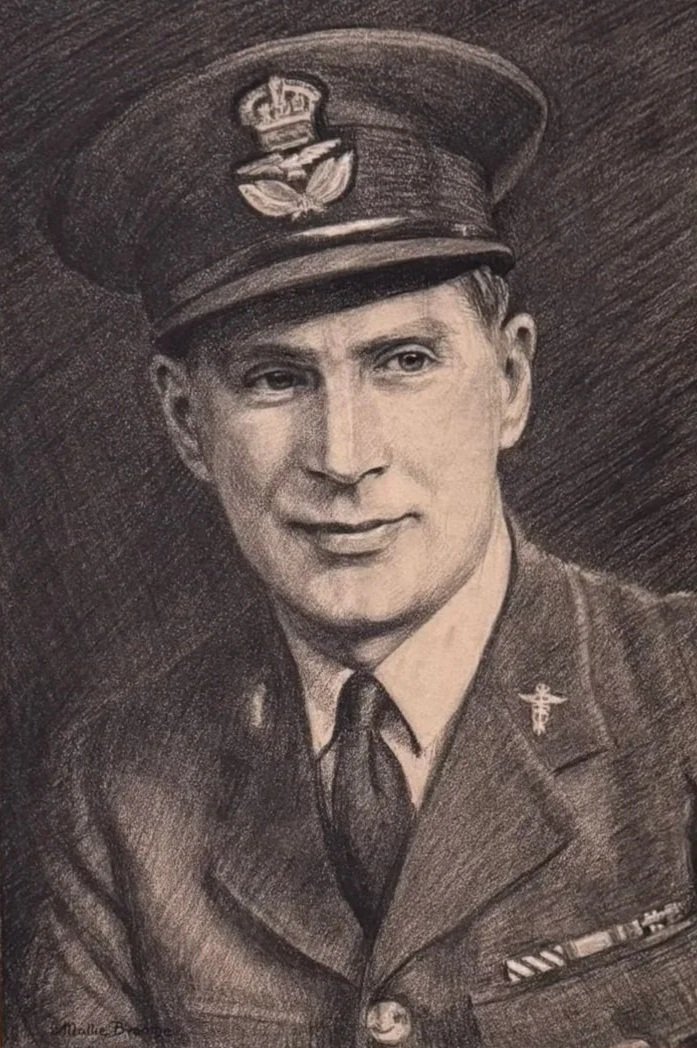
The visionary who set the human limits of flight and created the legacy modern aviation medicine stands on.
His research set the global standards for G-force protection, ejection safety, and high-altitude survival that protect aircrew to this day.

The aim of this site is to present a comprehensive overview of the life, leadership, and scientific achievements of William Kilpatrick Stewart, whose work shaped modern aviation medicine and aircrew survival.
A Legacy Written into Every Era of Flight
Air Vice-Marshal William Kilpatrick Stewart CB, CBE, AFC was one of the most influential figures in the history of aviation medicine.
As head of the RAF Institute of Aviation Medicine, he transformed wartime experimentation into a rigorous scientific discipline that shaped modern aircrew safety across the world.
From the physiology of acceleration and hypoxia to the design of life-saving equipment, Stewart’s work became the foundation of aerospace medicine as we know it.

Defining the Human Limits of Flight
Stewart’s research answered the question no one had yet solved:
How far can the human body be pushed in the sky?
He led pioneering studies in:
G-force tolerance
Rapid-onset blackout and recovery
High-altitude physiology and decompression
Pressure-breathing oxygen systems
Crash survivability and restraint design
Cold-weather and desert flight endurance
Ejection-seat physiology and spinal-injury prevention
These findings guided the development of the modern G-suit, safe ejection-seat profiles, and oxygen systems still in use across NATO air forces.
The Institute of Aviation Medicine
Building the World’s Leading Aeromedical Center
Under Stewart’s leadership, the RAF IAM at Farnborough became the world’s premier hub for aviation-physiology research.
He unified test pilots, physicians, and engineers into a single mission: understand the human body in flight, and improve the odds of survival.
The institute’s discoveries influenced:
Every generation of RAF fast-jet design
NATO aircrew standards
Early NASA reference studies
Modern survival-training doctrine
His work continues to inform air safety protocols decades after his passing.
Measured. Tested. Proven.
Stewart believed that aviation medicine should rely on evidence, not assumptions.
He insisted on precision testing, controlled trials, and direct physiological measurement.
His guiding principle became the cornerstone of modern aerospace-medical research.

“Our task is not to guess the limits of man, but to measure them.”— W.K. Stewart
Work That Still Shapes Today’s Flight Safety
His data remains part of aviation-medicine training worldwide.
Every pilot who flies with:
A G-suit
A pressure-breathing oxygen mask
A modern ejection seat
A pressurized cockpit
Cold-weather survival gear
…is benefitting from Stewart’s work.
A Legacy Still Felt in Every Cockpit
His contributions stand as one of the most significant legacies in the history of human flight.
His work changed what was possible in the air; and safeguarded all who followed.
SCIENTIFIC CONTRIBUTIONS
-
G-FORCE TOLERANCE AND ANTI-G PROTECTION
Major breakthroughs:Identified the precise cardiovascular mechanisms behind greyout → blackout → loss of consciousness under G-load.
Quantified the role of peripheral pooling in the legs and abdomen.
Developed the first scientifically validated anti-G trousers (G-suit prototypes) with inflatable bladders triggered by G-onset.
Demonstrated that G-onset rate (how fast G increases) is as physiologically important as total G.
Established minimum G-suit inflation pressures.
Standardized anti-G straining maneuvers for RAF pilots.
NASA later confirmed his G-suit data as foundational.
-
DECOMPRESSION & EXTREME ALTITUDE SURVIVAL
Stewart contributed to:Mapping the time to unconsciousness at various altitudes (20,000–50,000 ft).
Identifying critical oxygen partial pressures for aircrew survival.
Documenting the “time of useful consciousness” (TUC) during rapid decompression.
Establishing RAF protocols for pressurized cabin design.
Studying the pathology of decompression sickness and intravascular gas emboli.
His data is still used in modern aerospace-medicine curricula.
-
OXYGEN SYSTEMS & MASK PERFORMANCE
Stewart’s research shaped:
The transition from constant-flow to demand-regulated oxygen systems.
The first RAF evaluation of pressure-breathing oxygen masks.
Understanding how cold, low humidity, and high airflow affected mucosal drying and pilot performance.
Design refinements in masks used during the jet age and early supersonic aircraft.
His oxygen-system papers were routinely cited by USAAF and early NASA engineers.
-
PROTECTIVE CLOTHING FOR EXTREME TEMPERATURE
From NASA's Dressing For Altitude we know Stewart:
Flight-tested early pressurized leggings and heated clothing.
Conducted controlled exposure trials to determine survivable thresholds.
Defined standards for aircrew Arctic/altitude thermal protection that lasted into the 1970s.
He discovered that cognitive decline under cold stress occurred far earlier than physical impairment.
-
EJECTION-SEAT PHYSIOLOGY & HIGH-SPEED ESCAPE
Stewart established:
The spinal injury risk from vertical acceleration in ejection seats.
Human tolerance limits for upward acceleration.
Required minimum head/neck stabilization for safe ejection.
Optimal seat-rocket burn profile to minimize “spinal compression shock.”
Windblast injury thresholds at transonic speeds.
His data directly shaped Martin-Baker seat development.
-
PILOT PERFORMANCE & FATIGUE SCIENCE
Stewart’s long-form studies defined:
The impact of circadian rhythms on flight safety.
The cognitive effects of mild hypoxia and mild dehydration.
Early models of aircrew workload and task saturation.
This was the foundation of modern RAF human-factors doctrine.
-
ACCIDENT RESEARCH & SURVIVAL MEDICINE
Stewart oversaw:
Crash-survivability studies.
Injury-pattern mapping for RAF crash victims.
Improved restraint and harness design.
The first RAF guidelines for post-crash medical kits.
He pushed for the integration of medical officers in crash investigation teams — a now standard practice.
Events
24 November 2025
Royal Aeronautical Society Headquarters
The Stewart Memorial Lecture was established in 1969 to honour the life and work of Air Vice Marshal W K Stewart CB CBE AFC BSc MB ChB MRCP, who joined the staff of the RAF Physiology Laboratory in 1940 and commanded the RAF Institute of Aviation Medicine (which the RAF Physiological Laboratory became) from 1947 until his death in 1967.
Join us in person or online for the 2025 RAeS Stewart Memorial Lecture, where Professor David Newman AM HonFRAeS will present Fast Jet Aviation Medicine: Historical and Personal Perspectives.
Professor Newman’s presentation will combine an historical perspective on aviation medicine aspects of flying fast jets with his personal experiences in that environment. The focus will be on ejection, the physiological effects of high +Gz, cardiovascular adaptation and the development of protective countermeasures.